
A Case Study on How the World’s Largest Food Company Built Its Empire — and at What Cost
Introduction: More Than Just Maggi and KitKat
Think about the last time you reached for comfort food.
Maybe it was a quick bowl of Maggi after a long day, a cup of Nescafé during a late-night study session, or snapping a KitKat with a friend.
Nestlé isn’t just a brand — it’s part of everyday life.
It sits quietly in our kitchens, our routines, and our memories. There’s something almost comforting about it — familiar, reliable, almost too normal to question.
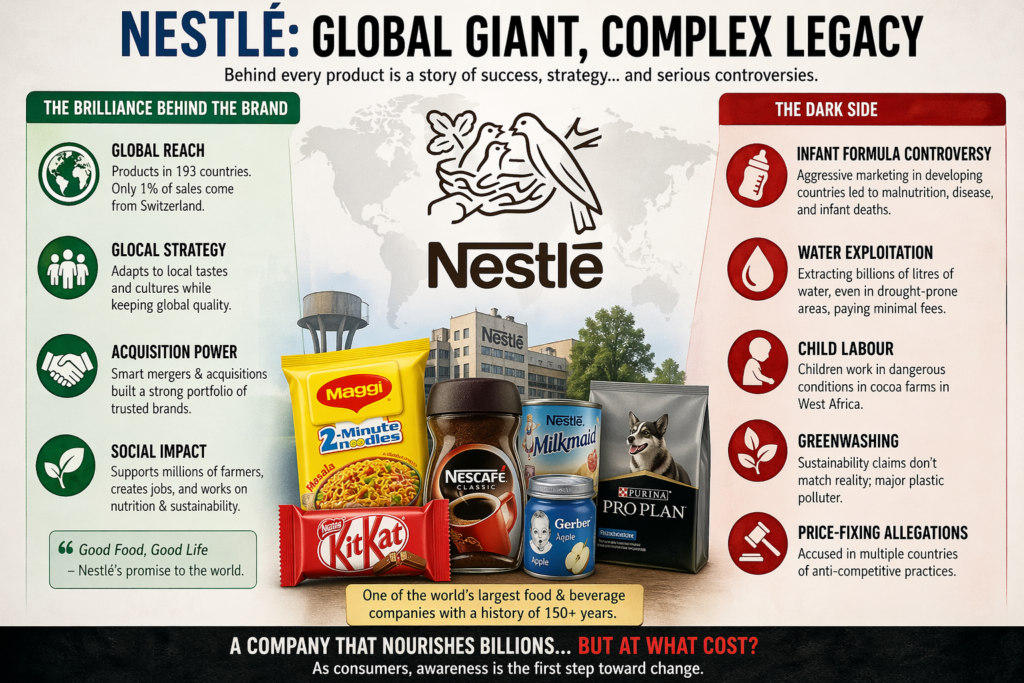
But here’s the thing: behind that warm, nurturing image — the one with the mother bird feeding her chicks — lies a story that’s far more complicated.
A story of brilliance.
Of global domination.
And yes… of decisions that have sparked outrage across the world.
This isn’t just about a food company.
It’s about how power works in today’s global economy.
From a Small Pharmacy to a Global Giant
Nestlé’s journey began in 1866 in a quiet Swiss town called Vevey.
A pharmacist, Henri Nestlé, created something called Farine Lactée — a simple mix of milk, wheat, and sugar designed to help infants who couldn’t be breastfed. It saved lives. That was the beginning.
From that moment, Nestlé wasn’t just selling food — it was selling nutrition, trust, and survival.
Then came growth. Massive growth.
By 1905, Nestlé merged with another company and never really looked back. Over the decades, it kept expanding — not slowly, but aggressively:
- Maggi (1947)
- Carnation (1985)
- Rowntree — the makers of KitKat (1988)
- Purina (pet care)
- Gerber (baby food)
By the late 1990s, Nestlé had built a presence in almost every corner of the world. Today, it operates in nearly 193 countries.
What’s wild? Only about 1% of its revenue comes from Switzerland — its home.
Nestlé didn’t just go global.
It became borderless.
The Real Strategy: Why Nestlé Wins Everywhere
1. Think Global, Act Local
Nestlé doesn’t treat the world as one big market. It adapts.
In India, Maggi tastes like masala.
In China, coffee is marketed differently than in Europe.
In Nigeria, they changed their entire distribution system just to deal with poor road infrastructure.
They don’t force products onto people.
They blend into cultures.
That’s their real superpower.
2. Betting Early on Emerging Markets
While others focused on developed countries, Nestlé went where growth was just beginning — India, Brazil, China, Africa.
They entered early, built trust with affordable products, and then expanded as incomes grew.
It’s not just smart — it’s patient strategy at scale.
3. Buying Instead of Building
Nestlé doesn’t reinvent the wheel.
If a strong local brand already exists, they buy it.
Then they scale it globally while keeping its local identity intact.
It’s like plugging a small brand into a massive global machine.
Nestlé in India: A Complicated Relationship
Nestlé entered India in 1961 with a factory in Moga, Punjab.
Today, it’s everywhere — from Maggi and Nescafé to KitKat and Milkmaid.
It also supports millions of livelihoods — especially farmers and suppliers.
But the story isn’t all smooth.
The Maggi Crisis (2015)
If you were in India in 2015, you remember this.
Maggi — the comfort food of an entire generation — was suddenly banned.
Authorities claimed it had high levels of lead and MSG.
Over 400 million packets were destroyed.
It was massive.
Nestlé denied the claims, fought back legally, and eventually won when the court lifted the ban.
And here’s the shocking part:
Maggi didn’t just survive — it came back strong, regaining about 60% of its market.
But the real question remains:
How does a product consumed for decades suddenly fail safety checks?
And how does a brand recover so quickly from something that serious?
That’s the power of trust — and also a warning about how fragile it is.
The Dark Side: Where Things Get Uncomfortable
Now we get to the part most people don’t talk about.
1. The Infant Formula Controversy
Back in the 1970s, Nestlé promoted baby formula in developing countries — aggressively.
Sales reps dressed as nurses approached new mothers, suggesting formula was better than breastfeeding.
But the reality was devastating:
- Many families couldn’t afford enough formula
- Mothers diluted it to make it last longer
- Water used was often contaminated
- Babies got sick — many died
Global outrage followed.
A boycott began in 1977 — and it still exists in some form today.
Even after WHO introduced strict guidelines in 1981, Nestlé has been accused of violating them multiple times.
2. Water: Resource or Commodity?
Nestlé has long been criticized for how it handles water.
In several regions:
- It extracted huge amounts of groundwater
- Paid very little for it
- Continued even in drought-prone areas
Meanwhile, local communities struggled with water shortages.
In some cases, Nestlé bottled and sold water from areas where people didn’t even have reliable access to clean drinking water.
That contradiction is hard to ignore.
3. Child Labour in Cocoa Supply Chains
Chocolate has a darker reality behind it.
Much of the cocoa used in products like KitKat comes from West Africa — where child labour is still a serious issue.
Reports have found:
- Children working long hours in dangerous conditions
- Some trafficked from nearby countries
- Farmers trapped in poverty
Despite promises to fix the issue, progress has been slow.
Deadlines were missed.
Problems remain.
4. Environmental Concerns
Nestlé talks a lot about sustainability — net-zero goals, recyclable packaging, etc.
But critics argue the gap between words and action is still large.
It’s often listed among the world’s biggest plastic polluters.
The question isn’t whether they’re trying — it’s whether they’re doing enough.
5. Price-Fixing Allegations
Nestlé has also faced legal issues around pricing in different markets.
In some cases, it paid fines or settlements without admitting wrongdoing.
For many critics, this points to a deeper pattern in how large corporations operate.
The Paradox of Nestlé
Here’s what makes this story complicated:
Nestlé has done real good.
- It has improved food access
- Supported farmers
- Invested in nutrition science
- Created jobs worldwide
And at the same time…
It has been involved in some of the most serious corporate controversies of the last few decades.
Both things are true.
That’s the paradox.
What This Really Teaches Us
- Big brands aren’t simple. They’re powerful — and power comes with consequences.
- Strategy can be brilliant, but ethics must keep up.
- Consumers matter. Awareness and pressure do make a difference.
- Accountability can’t be optional. It has to be enforced.
Conclusion: Look Beyond the Label
The next time you open a KitKat or make a cup of coffee, just pause for a second.
What you’re holding isn’t just a product.
It’s the result of 150+ years of innovation, strategy, influence — and controversy.
Nestlé’s story isn’t just about one company.
It’s about how the modern world works.
Understanding that doesn’t mean you have to stop buying their products.
But it does mean you’re no longer unaware.
And in today’s world, awareness is power.