
Series: Marketing & Business | Article 04 of 08
Target keywords: EEAT SEO, E-E-A-T content strategy, how to rank on Google 2026
Format: 2,000-word guide + checklist
Reading time: ~9 minutes
There’s a quiet revolution happening in search results right now, and the big brands aren’t winning it.
While Fortune 500 companies are pouring millions into content agencies and AI-generation pipelines, a solo consultant in Leeds is outranking them for the keywords that matter most. A two-person SaaS team in Austin is showing up above Salesforce on their own category terms. A local accountant with a basic WordPress site is beating a national firm in the search results her clients actually use.
This isn’t luck. It’s E-E-A-T — and it’s the most significant structural shift in SEO that small brands have ever had in their favor.
What E-E-A-T Actually Means (And Why It Suddenly Matters More)
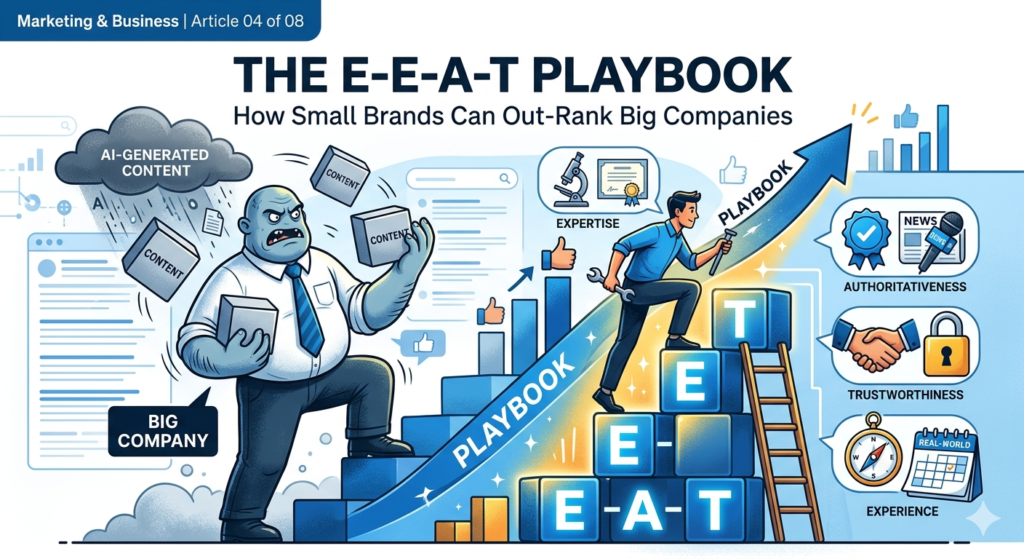
Google’s quality rater guidelines have long used the acronym E-A-T: Expertise, Authoritativeness, Trustworthiness. In late 2022, they added a fourth letter at the front — a second E for Experience — creating the framework we now use in 2026.
Here’s what each element means in plain terms:
Experience — Has the person writing this actually done the thing they’re writing about? Did they use the product, visit the place, work in the industry, or live through the situation?
Expertise — Do they have the knowledge to back it up? This could be formal (a medical degree) or informal (a decade of hands-on work in a niche).
Authoritativeness — Is the source recognized and cited by others in the field? Do other credible sites mention or link to them?
Trustworthiness — Is the website safe, accurate, honest, and transparent about who is behind it?
For years, large brands dominated these signals simply through their size. They had domain authority built over decades, editorial teams, and PR budgets that generated thousands of backlinks. A small brand could do everything “right” and still lose to a corporate competitor just because of institutional weight.
That dynamic is changing fast — and here’s why.
Why the Algorithm Has Shifted in Your Favor
Two things happened in 2024 and 2025 that rewired Google’s quality signals in ways small brands can exploit.
First, the internet flooded with AI-generated content. Enterprise companies, media conglomerates, and content mills all turned on the tap. The web became saturated with technically accurate but experientially empty articles — posts that answer questions without any evidence of someone actually having faced them. Google’s response was aggressive. A series of core updates, most notably the helpful content updates and the June 2025 core update, specifically targeted content that lacked genuine human experience and deprioritized pages that read like they could have been written by anyone, about anything, for no one in particular.
Second, Google got better at reading signals of real experience. The algorithm now rewards specificity that only comes from lived knowledge — the kind of detail that a large content team optimizing for keywords at scale simply can’t fake consistently. A plumber writing about why a specific pipe fitting fails in older buildings in a particular city is producing exactly what Google wants to rank. An enterprise brand publishing a generic “top 10 plumbing tips” listicle is not.
The result: the E-E-A-T playing field has flattened considerably. What you know, what you’ve done, and who trusts you now matters more than the size of your content budget.
The Four Pillars: A Practical Playbook
Pillar 1 — Demonstrate Experience, Don’t Just Claim It
This is where most small brands leave points on the table. They know their industry inside out, but they write content that sounds generic because they think that’s what “professional” looks like.
It isn’t.
Google’s systems are now specifically looking for markers of first-hand experience. These include: specific numbers and results from real situations, mentions of failures as well as successes, references to particular tools or methods you actually use, and the kind of opinionated stance that only comes from having done the work.
What this looks like in practice:
Instead of writing “Content marketing can help grow your business,” write: “When we switched from publishing three posts a week to one deeply-researched piece, our organic traffic dropped for 60 days and then tripled over the following six months. Here’s what we learned.”
Instead of “Social proof is important,” write: “The single change that moved our conversion rate from 1.8% to 4.3% was adding a customer quote directly below the pricing section — not in a testimonials page nobody reads.”
Specificity is the signal. It’s the one thing AI-generated content struggles to replicate and the one thing you have in abundance.
Tactical moves:
- Add a “What I actually found” or “From our own testing” section to every cornerstone article
- Include screenshots, real data, and dated results rather than hypothetical examples
- Write case studies using actual client work — with numbers, named industries, and specific challenges
Pillar 2 — Build Author Authority That Google Can Verify
One of the most underused trust signals in small business SEO is the author profile. Large brands often publish content under a generic brand byline or rotate through freelancers without establishing any individual expertise. This is a gap you can exploit.
Google increasingly evaluates the author of a page, not just the domain. A named expert with a verifiable track record — podcast appearances, LinkedIn presence, published quotes in trade media, a clearly linked bio — generates E-E-A-T signals that accumulate over time and apply across every article they write.
What this looks like in practice:
Every article on your site should have a named author. That author’s bio page should include: their credentials or relevant experience, links to their LinkedIn and other verifiable profiles, any media mentions or speaking engagements, and a clear description of what they’ve actually done in the field — not just job titles.
This isn’t vanity. It’s discoverability infrastructure. When AI search tools and Google’s quality raters assess your content, the author entity is part of the trust calculation. A well-built author profile turns every post you write into a compounding authority asset.
Tactical moves:
- Create individual author pages with bios, credentials, and external links
- Get quoted in trade publications, even small ones — a mention from an industry newsletter counts
- Set up a Google Knowledge Panel by claiming your business on Google and linking your website to authoritative profiles
- Use structured data (Person schema) to explicitly tell search engines who wrote each piece
Pillar 3 — Build Trustworthiness Into the Site’s Architecture
Trust signals operate at two levels: the content level and the site infrastructure level. Most brands focus entirely on content and ignore the infrastructure — and it’s costing them rankings.
At the site level, trustworthiness means:
Transparency about who you are. An About page that names the founders, shows real photos, explains your history, and makes contact information easy to find. Enterprise brands often fail here because their About pages are corporate boilerplate that reads like an investor relations document. Yours should read like a person.
Proof blocks on every key page. A proof block is a short section — it can be two or three sentences — that answers the question: why should anyone trust this content? It names who wrote it, why they’re qualified to write it, when it was last reviewed, and what sources or data it draws from. These are easy to add and the kind of transparency signal that correlates with improved rankings after quality-focused updates.
A clean privacy and legal setup. Privacy policy, terms of use, a genuine returns or contact policy if you’re in commerce. These aren’t just legal requirements — they’re trust signals that Google’s quality raters literally check.
Genuine third-party validation. Reviews on Google, Trustpilot, or industry-specific directories. Accreditations displayed with links back to the accrediting body. Media logos with links to the actual coverage. Not just the logo — the link. The link is what makes it verifiable.
Tactical moves:
- Audit your About page and rewrite it in a human voice with named individuals and real history
- Add proof blocks to your 10 most important pages this month
- Ensure every review platform you appear on is updated, responded to, and linked from your site
- Publish original research, even small studies — a survey of 50 customers with real data is highly citable
Pillar 4 — Build Authority Through Strategic Visibility
Authoritativeness — the third letter in E-E-A-T — is the one most small brands treat as out of reach. They assume it requires a massive PR budget or years of industry networking. In reality, the bar is lower than you think, and the strategy is very specific.
Authoritativeness is built by being cited. Not just linked to — cited. It means other credible sources reference your work, your research, your opinions, or your data. And the fastest way to earn citations is to publish things worth citing.
This means: original data, even from small samples. Frameworks that others can reference and build on. Contrarian takes backed by evidence. Tools, templates, and calculators that become go-to resources in your niche. Any piece of content where someone would naturally say “as [your brand] found” when making their own argument.
The second fastest way is earned media — not press releases, but genuine expert commentary. Offer your perspective to journalists through tools like HARO (Help a Reporter Out) or Qwoted. Appear on podcasts in your niche, even small ones. Guest post on publications your customers actually read.
One quality mention from a relevant trade publication does more for your domain authority than fifty generic directory listings. One podcast appearance where you share a genuinely useful insight will earn more trust signals than a month of generic social posts.
Tactical moves:
- Identify five pieces of original data you could publish in the next 90 days (customer surveys, internal benchmarks, industry observations)
- Reach out to three podcasts in your niche and pitch a specific angle, not a general “I’d love to be a guest” email
- Set up alerts for topics you know well and respond to journalist queries consistently
- Create at least one publicly shareable resource (a template, calculator, or checklist) that others would genuinely want to link to
The E-E-A-T Audit Checklist
Use this to score your current site and prioritize what to fix first.
Experience signals
- Articles include specific, dated results from real situations
- Content contains genuine opinions, not just neutral summaries
- Case studies use real numbers and named industries
- “How we tested this” or “What we found” sections present on cornerstone posts
Expertise signals
- Named authors on all articles with linked bios
- Author bios include specific credentials and relevant experience
- Person schema markup applied to author pages
- Authors have verifiable external profiles (LinkedIn, professional associations)
Authoritativeness signals
- At least one piece of original research or data published in the last 6 months
- Earned mentions from relevant trade or industry publications
- Podcast appearances or speaking engagements linked from the site
- Internal linking structure connects related content into clusters
Trustworthiness signals
- About page names real people with real history
- Proof blocks present on all key service/product pages
- Privacy policy, terms, and contact details complete and easy to find
- Third-party reviews on at least two platforms, actively managed
- Media mentions linked (not just logos shown)
- Content is dated and reviewed dates are visible
The Honest Truth About Timelines
E-E-A-T is not a quick fix. The brands that dismiss it because it doesn’t show results in two weeks are the same brands that will still be losing to smaller, more trusted competitors in two years.
The good news: the signals compound. Every author profile you build, every original data point you publish, every podcast you appear on, every genuine review you earn — these stack. A focused 90-day sprint on E-E-A-T foundations has, for many brands, closed the trust gap against domains with 10 years of age advantage.
Start with the checklist above. Pick the three items where your score is lowest. Fix those first. Then move to the next three.
Big brands have budgets. You have something they can’t buy at scale: genuine experience, real relationships, and the ability to write like a specific human being about a specific thing for a specific audience.
In 2026, that’s not a consolation prize. That’s your competitive advantage.
This is Article 04 in the Marketing & Business Blog Series. Read Article 03: GEO vs. SEO: A Practical Guide for Marketers Who Don’t Want to Chase Every Trend or continue to Article 05: Why Most Businesses Are Measuring Marketing ROI the Wrong Way.
About this series: Eight articles built around what actually drives marketing growth in 2026 — from search architecture to brand authority. Written for founders, in-house marketers, and consultants who need strategies that work without enterprise-level budgets.