
What exactly are we talking about?
Artificial Intelligence (AI) is no longer science fiction. It’s the algorithm that recommends your next playlist, the system that flags fraudulent transactions on your credit card, and the engine powering tools that help doctors detect cancer earlier than ever before.
Machine Learning (ML) is the engine inside AI — a set of techniques that lets computers learn patterns from data, rather than being explicitly programmed with every rule. Think of it like teaching by example, not by instruction manual.
“AI is the dream. Machine learning is how we’re actually building it — one pattern, one dataset, one model at a time.”
The scale is staggering
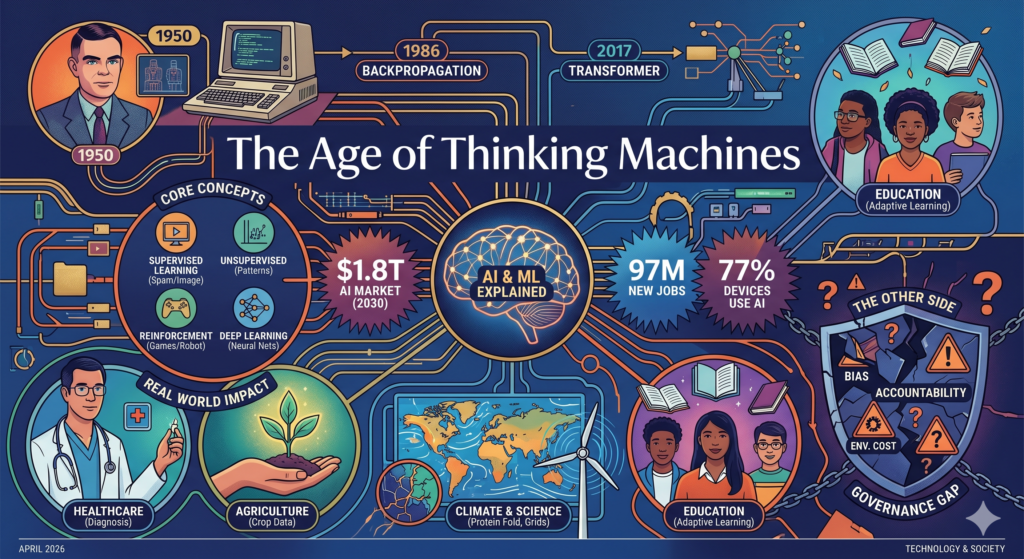
$1.8T
Projected AI market by 2030
97M
New AI-related jobs forecast by 2025
77%
Of devices use AI in some form today
The building blocks of machine learning
There are several major flavors of ML, each suited to different kinds of problems:
Supervised learning
Learns from labeled examples. Used in spam filters, image classifiers, and price prediction.
Unsupervised learning
Finds hidden patterns without labels. Powers customer segmentation and anomaly detection.
Reinforcement learning
Learns by trial and reward. Used in game-playing AI, robotics, and trading strategies.
Deep learning
Neural networks with many layers. Behind image recognition, large language models, and speech.
How we got here
- 1950Alan Turing asks “Can machines think?”
The Turing Test is proposed — a philosophical milestone that sparked decades of inquiry.
- 1986Backpropagation unlocks neural networks
A training algorithm that lets multi-layer networks learn — the foundation of modern deep learning.
- 2012AlexNet wins ImageNet — a watershed moment
A deep neural network crushes the competition in image recognition, proving deep learning’s dominance.
- 2017“Attention is All You Need” — the Transformer
Google’s architecture becomes the backbone of GPT, BERT, and every major language model since.
- 2022–NowGenerative AI enters everyday life
ChatGPT, Claude, Midjourney, Gemini — AI becomes a daily tool for hundreds of millions of people.
Where AI & ML are changing lives
Healthcare: ML models now detect diabetic retinopathy, skin cancer, and cardiac abnormalities from images — often outperforming specialists in screening accuracy. Early detection saves lives.
Climate & Science: DeepMind’s AlphaFold solved a 50-year-old protein folding problem, accelerating drug discovery. AI models also optimize energy grids and model climate systems far more efficiently than classical methods.
Agriculture: Computer vision and satellite data help farmers detect crop disease early, optimize irrigation, and predict yields — critical as the planet faces food security challenges.
Education: Adaptive learning systems personalize curricula to each student’s pace and strengths, making quality education more accessible globally.
The questions we can’t ignore
Progress always comes with tensions. As AI systems grow more capable, so do the concerns around them. Bias in training data can encode and amplify societal inequalities. Autonomous systems making high-stakes decisions raise serious questions about accountability. The environmental cost of training massive models is non-trivial.
“The technology is advancing faster than our governance of it — and that gap is where the real risks live.”
The good news: these aren’t unanswerable problems. Researchers in fairness, interpretability, and AI safety are working to build systems that are not just powerful — but trustworthy. The conversation matters as much as the code.
We are at the beginning, not the end.
The most consequential applications of AI may not yet exist. The question isn’t whether intelligent systems will transform the world — it already is. The question is whether we’ll shape that transformation with intention, equity, and care.