“They Weren’t Just In It for the Money” — Meta’s AI Chief Alexandr Wang Has Had Enough of the Mercenary Narrative
May 15, 2026
There’s a story that has been circulating in tech circles for months now, and it goes something like this: Meta needed to catch up in the AI race, so Mark Zuckerberg simply opened his checkbook, waved $100 million compensation packages in front of the best researchers in the field, and bought himself a world-class AI lab. Talent doesn’t follow vision — it follows money, and Meta had more of it than almost anyone.
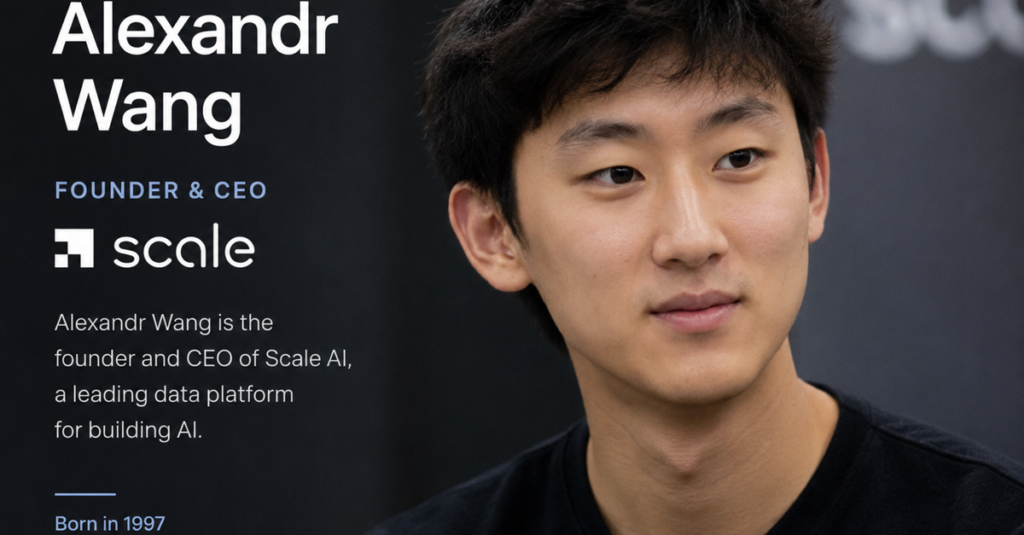
Alexandr Wang, Meta’s chief AI officer and the man at the centre of that story, is not particularly pleased with how it’s being told.
The Pushback
Speaking on the Core Memory podcast with journalists Ashlee Vance and Kylie Robison, Wang pushed back firmly on what he called “an incorrect assumption” — the idea that the researchers who joined Meta’s SuperIntelligence Lab did so purely because of the staggering financial offers.
“This is one of, I think, the larger — I would say — narrative violations or maybe like differences between external perception and what the day-to-day inside is like actually,” Wang said.
He didn’t deny the money exists. He couldn’t, really — Business Insider had previously reported that Meta was dangling packages reportedly reaching $100 million when equity was included. But Wang’s point was more nuanced: these researchers weren’t desperate people jumping at a lifeline. They were already sitting pretty.
“For most of them, the financial prospects of staying wherever they were looked very good as well,” he said. Their prospects at their prior employers were, in his words, “very, very, very strong.”
So if not the money, then what?
What Actually Attracted the Best Researchers
Wang laid out three things he believes genuinely drove his team to Meta, and they’re worth taking seriously — because if he’s right, it tells you something important about what elite AI researchers actually want.
Compute. Not just access to it, but a lot of it per researcher. Wang said people joined because of “high compute per researcher” — meaning each person had more raw computing power at their disposal than they would have had almost anywhere else. In AI research, this is not a small thing. Compute is the bottleneck. It’s the difference between running an experiment once and running it a hundred times. It’s the difference between a hypothesis and a discovery.
Talent density. Wang described the lab as “a truly cracked group that was pretty small.” There’s something magnetic about being in a room — metaphorically or literally — where everyone around you is operating at the absolute frontier. Top researchers want to work with other top researchers. It’s not about ego; it’s about the quality of conversation, the speed of iteration, and the fact that great ideas get challenged by people who know what they’re talking about.
Freedom to make bold research bets. This might be the most important one. Wang said Meta was giving researchers “the resources and freedom to make very bold research bets.” In big tech companies, especially those with quarterly earnings calls and product roadmaps, that kind of freedom is genuinely rare. Research that doesn’t pay off in eighteen months tends to get defunded. Wang is pitching Meta’s lab as a place where long-horizon, paradigm-shifting bets are not just tolerated — they’re the point.
He also emphasised that the recruiting process itself was unusually personal. “Part of the premise of building this lab was also that we had to show everyone that we really, really cared about this technology and we cared about their specific research directions and what they were working on,” he said. “And it was a very individualised recruiting process.”
Who Exactly Are These People?
The SuperIntelligence Lab is not a generic collection of engineers. A few names help illustrate just how serious Meta’s recruitment drive was.
Wang himself is the most prominent hire. Meta spent $14.3 billion to acquire a 49% nonvoting stake in his company Scale AI, and in the process brought him in as Meta’s first-ever chief AI officer — a title that had never existed at the company before. He was 28 at the time, already one of the most prominent figures in the AI industry, and now leads the entire Meta Superintelligence Labs unit.
Then there’s Nat Friedman — former CEO of GitHub, a man who had already built and run one of the most important developer platforms in the world, and who is now helping lead the development of AI products at Meta.
Ruoming Pang came from Apple, where he was head of foundation models — a role at the intersection of Apple’s most secretive and consequential work.
Trapit Bansal arrived from OpenAI, one of the most sought-after AI employers on the planet.
These are not people who took the first good offer they received. They are people who had options, and they still chose Meta.
Why This Narrative Even Exists
To understand why the “money-motivated mercenaries” framing took hold, you have to understand the context.
Meta’s AI standing had taken a beating. Its previous flagship model, Llama 4, launched in April 2025 to widespread criticism — independent researchers discovered that Meta had benchmarked a specially fine-tuned version of the model, not the one actually available to users. The community felt deceived. And before Wang arrived, Meta’s chief AI scientist Yann LeCun, one of the most respected figures in deep learning, had reportedly refused to report to Wang and eventually departed to start his own venture.
Zuckerberg’s response was to essentially rebuild the lab from scratch. He hired Wang, committed to spending between $115 billion and $135 billion on AI-related capital expenditure in 2026 alone — nearly double the previous year’s spend — and went on a talent acquisition spree that made the rest of the industry’s head spin.
When you’re throwing those kinds of numbers around, people are going to assume the talent followed the dollars. Wang’s argument is that this gets the causality backwards, or at least oversimplifies it.
What Has the Lab Actually Produced?
The proof of concept arrived in April 2026, when Meta’s SuperIntelligence Labs debuted Muse Spark — originally codenamed “Avocado.” It was the first major model to come out of Wang’s lab, and the first proprietary, closed-source AI model in Meta’s history (a significant departure from the open-source Llama approach).
By Meta’s own benchmarks, Muse Spark is competitive with leading models from OpenAI, Anthropic, and Google across many tasks, though it doesn’t comprehensively beat them. Wang himself described it as “an early data point on our scaling trajectory — the appetiser.” The model is notable for using far fewer tokens than comparable models for similar results — a sign that the rebuilt tech stack Wang’s team constructed from scratch has real engineering merit.
The lab is currently working on what comes next. Wang has hinted that future models will be “state-of-the-art in some areas,” and Meta’s massive compute infrastructure is being positioned as the engine that makes aggressive scaling possible.
The Bigger Question No One Is Asking
Here’s the thing that gets lost in the money-versus-mission debate: both can be true at the same time.
Wang is right that reducing his researchers to mercenaries is unfair and probably inaccurate. These are people who care deeply about the work, who have specific research directions they want to pursue, who are attracted by the rare combination of compute, freedom, and peer quality that Meta is offering.
But it’s also true that when every researcher on your team already had “very, very, very strong” financial prospects and you still managed to recruit them, the $100 million packages probably didn’t hurt. The narrative Wang objects to isn’t wrong because money played no role — it’s incomplete because money was one factor among several, and perhaps not the decisive one for most of these individuals.
What Wang seems to be protecting is something more important than compensation optics: the culture of the lab. If your team believes it got hired because it was brilliant and motivated by a genuine mission, that belief shapes how they work. If they think they’re just well-compensated mercenaries in a corporate arms race, that shapes something else entirely.
The distinction matters. And Wang knows it.
What This Tells Us About the AI Talent War
The broader AI talent war is unlike anything the tech industry has seen before. The number of people who can genuinely push the frontier of AI research is remarkably small — perhaps a few thousand worldwide. Every major lab, from OpenAI to Google DeepMind to Anthropic, is competing for the same pool of talent, and they’re all offering extraordinary packages.
In this environment, money becomes table stakes relatively quickly. When everyone is offering life-changing compensation, the differentiating factor shifts. What kind of research can I do here? How much compute will I have? Who are my colleagues? Can I take the risks I actually want to take?
If Wang’s account is accurate — and there’s no obvious reason to disbelieve him — Meta answered those questions well enough to attract some of the most sought-after names in the field. That’s not nothing. In fact, it might be the most important strategic achievement of Zuckerberg’s expensive AI gamble so far.
The first Muse Spark model may not have dethroned OpenAI or Google. But the lab is built, the stack has been rebuilt from scratch, and the team is intact. Whether that translates into genuine frontier-level AI in the next twelve to eighteen months is the real question — and it’s one that even ₹100 million packages can’t answer.
Only the research can.
Muse Spark is currently available on the Meta AI app and web platform. Meta’s SuperIntelligence Labs continues to develop future models in what Wang describes as a multi-phase scaling trajectory.