
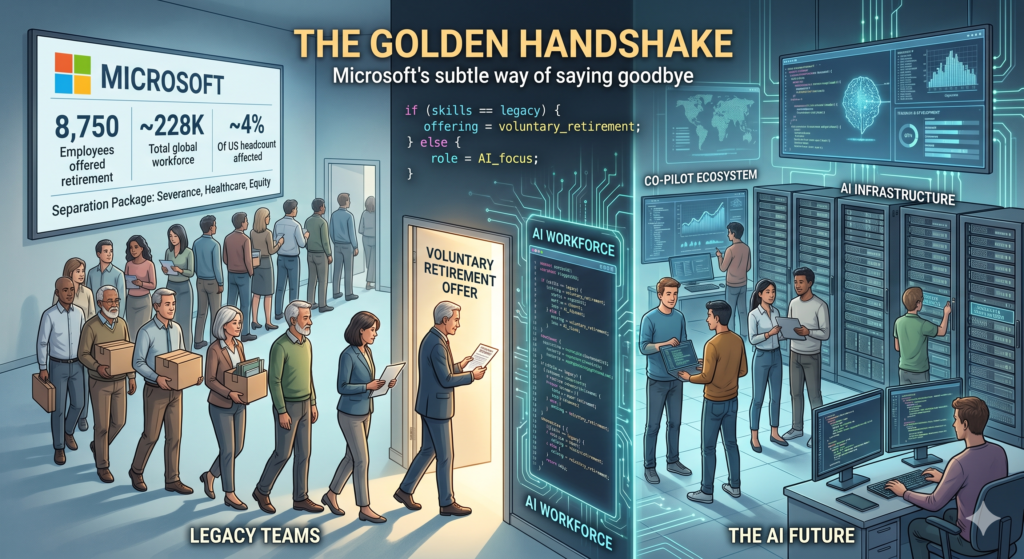
8,750
Employees offered retirement
~228K
Total global workforce
~4%
Of US headcount affected
Let’s be honest — “voluntary retirement offer” is corporate speak that most of us have learned to decode. When a company hands nearly 9,000 employees a package and says “hey, want to leave on your own terms?”, it’s rarely because things are going great.
Microsoft’s latest move affects roughly 8,750 employees in the United States, making it one of the more significant workforce restructuring efforts the company has undertaken in recent years. And while Redmond hasn’t exactly been shouting about it from the rooftops, the details that have emerged paint a fairly clear picture of where the company’s priorities lie right now.
- “Voluntary” doesn’t mean the pressure isn’t real. It means the company found a gentler way to shrink headcount.
What we know
The offer, in plain English
Eligible employees — most of them longer-tenured workers — are being given the option to retire early with what Microsoft describes as a “separation package.” The specifics of what that package includes haven’t been fully disclosed publicly, but these programs typically bundle severance pay, extended healthcare coverage, and sometimes accelerated vesting on equity.
The 8,750 figure is notable. That’s not a small departmental shuffle. That’s the kind of number that signals a company-wide rethink of how resources are deployed — especially as Microsoft continues its massive bet on AI infrastructure, which requires a very different skill mix than the enterprise software teams it built over decades.
Reading between the lines
This isn’t happening in a vacuum
Microsoft has been on a cost-optimization tear. In 2023, it laid off 10,000 employees. It’s made headlines since for trimming teams across gaming (post-Activision acquisition), hardware, and various product divisions. The voluntary retirement program fits neatly into that broader pattern — it’s just the more palatable version of a layoff, at least from a PR standpoint.
There’s also the AI angle you simply can’t ignore. Microsoft has poured tens of billions into OpenAI and its own Copilot ecosystem. That kind of investment demands returns, and returns demand efficiency — which often means doing more with fewer people, especially in roles that AI can increasingly assist or replace.
- The irony of an AI company offering early retirement to thousands of workers is not lost on anyone paying attention
For the employees involved
What this actually means for people
If you’re one of the 8,750 people who received this offer, here’s the real-talk version: this is a decision that deserves careful thought, not a snap reaction. Voluntary retirement packages can be genuinely good deals — especially if you were already thinking about winding down your career. But they can also feel coercive, even when they’re not technically mandatory.
The pressure is real. Even if no one is forcing anyone out the door, accepting such an offer often feels like reading the writing on the wall. Many employees will weigh the package against the uncertainty of staying — and for some, the math will favor leaving.
The bigger picture
What this says about Big Tech right now
Microsoft isn’t alone in this. Across the industry, large tech companies are doing a version of the same thing: rightsizing legacy teams while doubling down on AI capabilities. The voluntary retirement route is arguably more humane than sudden layoffs, but the underlying logic is the same.
What’s worth watching is what happens next. Do the workers who stay see their roles transform around AI tools? Do the teams that remain get leaner and more productive — or just leaner? The answers to those questions will tell us a lot more about Microsoft’s direction than the headline number ever could.
For now, 8,750 people are weighing a decision that will shape the next chapter of their lives. That’s the part of these announcements that tends to get lost in the business coverage. Behind every workforce restructuring is a lot of people having very real, very personal conversations at home.