Startup Story · Quick Commerce
How two 17-year-olds skipped Stanford, bet everything on 10-minute grocery delivery, and built one of India’s most exciting startups.
It all started in 2020 during the pandemic. Two 17-year-old friends in Mumbai — Aadit Palicha and Kaivalya Vohra — were stuck at home like everyone else, frustrated that getting groceries delivered could take hours. Most people just complained. These two decided to do something about it.
What came next is one of the most remarkable startup stories to come out of India in recent years. A company built by teenagers, growing at a speed that stunned investors, and changing the way millions of Indians shop for everyday essentials.
Who Are the Founders?
Aadit Palicha and Kaivalya Vohra were both bright students from Mumbai who had earned admission to Stanford University — one of the most competitive schools in the world. Most people would call that a dream come true. These two called it a reason to think.
They had already been experimenting with a grocery delivery service called KiranaKart before Zepto came along. The idea was simple: connect local kirana stores to customers online and deliver in about 45 minutes. It worked to some extent, but the founders weren’t satisfied. Users kept asking for faster delivery. And the founders kept asking themselves — how much faster could we actually go?
So they made a decision that shocked their families: they deferred Stanford and went all-in on a new, bolder idea. They were 18 years old.
“We didn’t want to build something that was just a little better. We wanted to do something that felt like magic to the customer.”
— Aadit Palicha, Co-founder & CEO, Zepto
The Big Idea: Groceries in 10 Minutes
The core insight behind Zepto sounds almost too simple: if you put a small warehouse close enough to where people live, you can deliver groceries in 10 minutes. That’s it. No tricks, no complex tech gimmick. Just location, speed, and obsessive execution.
These small warehouses are called dark stores — they aren’t open to the public, only to Zepto’s own delivery staff. Each one stocks around 2,000 to 3,000 of the most commonly ordered items, organized purely for fast picking. A delivery partner picks the order, packs it, and rides out — all within a 2 to 3 kilometre radius of the customer.
Why dark stores work: A normal supermarket is designed for customers to browse. A dark store is designed for a picker to move fast. Smaller catalog, smarter layout, dedicated staff — all of this shaves minutes off every order. Place it close enough to customers and 10-minute delivery stops being a dream and starts being a system.
Zepto wasn’t the first company to try quick commerce in India. Blinkit and Swiggy Instamart were already in the game. But Zepto did something different — it made 10 minutes the entire identity of the brand, not just a feature. That focus changed everything about how the company operated and how customers thought about it.
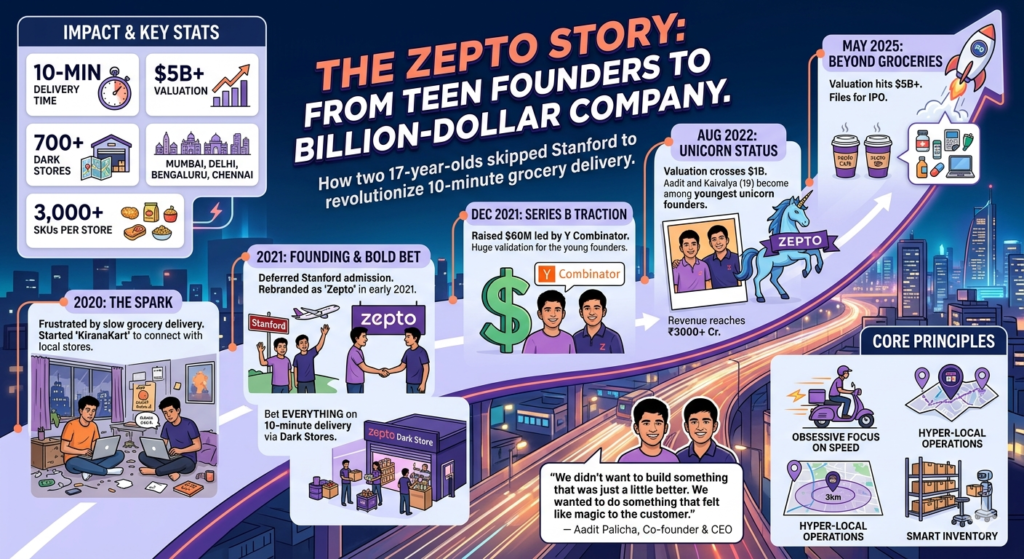
How It All Grew: The Timeline
The Struggles Nobody Talks About
Behind all the funding headlines and valuation milestones, building Zepto was genuinely hard in ways most people don’t see.
First, there was the credibility problem. When you are 18 and trying to hire experienced managers, operations heads, and tech leads — people who are 10 or 15 years older than you — many of them simply don’t take you seriously. Aadit and Kaivalya have talked openly about how many conversations ended with polite rejections before they found people who believed in what they were building.
Then there’s the business itself. Quick commerce has notoriously tricky unit economics. Every single order requires a stocked dark store, a trained picker, and a delivery partner — all within a tight geographic window. In the early days, growth often meant growing losses at the same time. The founders had to expand fast enough to win market share while simultaneously proving to investors that the business could eventually make money.
“Everyone said the 10-minute model was unsustainable. We just had to prove the economics could work while also proving the demand was real.”
— Kaivalya Vohra, Co-founder & CTO, Zepto
Competition was intense too. Blinkit had Zomato’s resources behind it. Swiggy Instamart had an existing delivery network. Zepto had to out-execute both of them with a younger team and fewer resources. That’s not easy. But it turns out it’s possible.
How Zepto Makes Money
Zepto earns from a few different sources. The most obvious is delivery fees — charged per order, though often reduced or waived for larger baskets to encourage customers to spend more in one go.
The bigger revenue lever is advertising and brand partnerships. Consumer goods companies — think biscuit brands, dairy companies, personal care products — pay Zepto for premium placement within the app, sponsored listings, and promotional campaigns. This has been a major factor in improving profitability over time.
Zepto has also started building out private label products — its own branded goods that carry better margins than third-party items. It’s a playbook borrowed from supermarket chains worldwide, and early results look promising.
What Makes Zepto Stand Out From the Competition
Speed is the obvious answer, but it’s not the only one. What really sets Zepto apart is the cultural obsession with the 10-minute promise. Every part of the company — from how dark stores are designed, to how inventory is managed, to how delivery routes are planned — is built around that single constraint. That level of focus is surprisingly rare.
The founders also showed the ability to learn and adapt quickly. They were willing to kill KiranaKart and start Zepto when they realized a 45-minute delivery wasn’t good enough. That willingness to tear down what you’ve built and start fresh — rather than defend it — is a quality that defines the best startup founders.
What Comes Next
Zepto’s IPO filing is the next big milestone. Going public would put the company under a completely different level of scrutiny — from analysts, journalists, and everyday retail investors. The profitability story will matter more than ever.
There’s also the question of where Zepto goes beyond groceries. The platform has already expanded into café items through Zepto Café. Can medicines, electronics, or fashion be next? The 10-minute model has more room to grow, but each new category is its own challenge.
The competitive landscape won’t get easier either. Blinkit, Swiggy Instamart, and potentially Amazon and JioMart will all fight hard for the same customers. Winning long-term means building loyalty that goes beyond just being fast.
The Real Lesson Here
Zepto’s story is often told as a “teen founders become billionaires” narrative. That’s a fun headline, but it misses what’s actually interesting about the company.
What Aadit and Kaivalya did right wasn’t just building a delivery app. They identified a real gap — people want things fast, not just “faster than before” — and committed to solving it at a level that felt almost unreasonable to everyone around them. They picked the right model (dark stores, not courier-style delivery), chose the right market (post-pandemic India with booming digital adoption), and executed with a speed and intensity that older, more cautious founders might never have attempted.
They also knew when something wasn’t working and changed direction. That’s a skill most people don’t develop until much later in life, if ever.
Zepto is still a young company with a lot to prove. But it’s already shown that with the right idea and relentless focus, age is just a number — and 10 minutes is more than enough time to change an industry.