
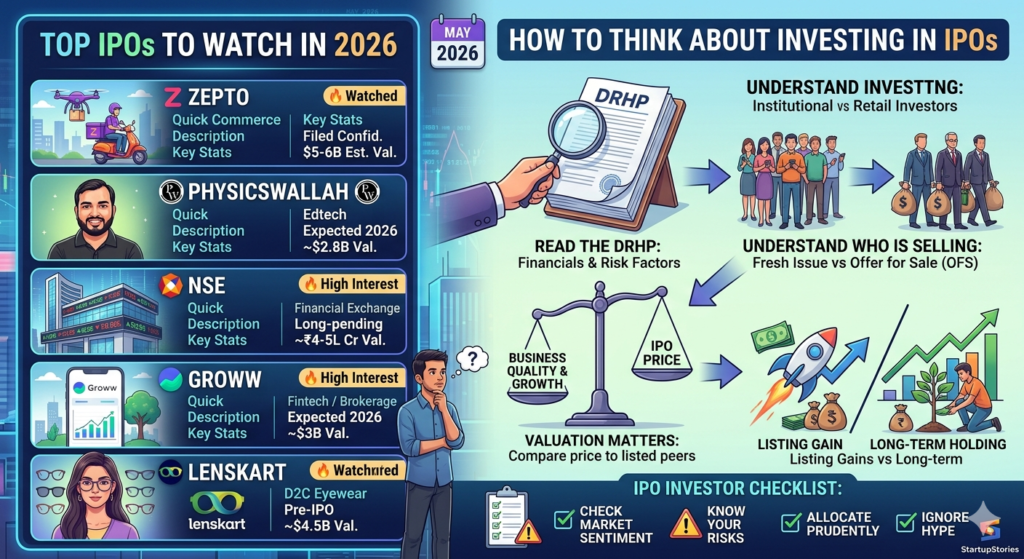
Top Upcoming Indian IPOs in 2026: Best IPOs to Watch Before Investing
From quick-commerce giants to edtech unicorns — here’s a plain-language guide to the most talked-about Indian IPOs expected in 2026 and what you should know before investing.
2026 is shaping up to be a big year for Indian IPOs. After a strong 2024–25 market, several well-known startups and established businesses are finally making their way to the public markets. For retail investors, this means more opportunities — but also more noise to cut through.
This guide covers the most important upcoming IPOs expected in 2026, what each company actually does, what the numbers look like, and — most importantly — what risks you should understand before putting your money in.
We are not recommending you buy or avoid any of these. We are giving you the information to make your own informed decision.
Important: IPO timelines in India can shift. SEBI approvals, market conditions, and company decisions can delay or cancel listings. The information here is based on publicly available reports as of May 2026. Always check the official DRHP (Draft Red Herring Prospectus) before investing in any IPO.
Quick Summary: IPOs to Watch in 2026
| Company | Sector | Expected Valuation | Status |
|---|---|---|---|
| Zepto | Quick Commerce | $5–6 billion | Filed confidentially |
| PhysicsWallah | Edtech | ~$2.8 billion | Expected 2026 |
| NSE (National Stock Exchange) | Financial Exchange | ~₹4–5 lakh crore | Long-pending, awaited |
| Groww (Nextbillion) | Fintech | ~$3 billion | Expected 2026 |
| Boat (Imagine Marketing) | Consumer Electronics | ~$1.5 billion | Re-filing expected |
| Lenskart | D2C Eyewear | ~$4.5 billion | Pre-IPO stage |
| Meesho | Social Commerce | ~$3.9 billion | Pre-IPO stage |
The IPOs — One by One
 Most Watched
Zepto is India’s fastest-growing 10-minute grocery delivery company, built by teenage founders Aadit Palicha and Kaivalya Vohra. It operates hundreds of dark stores across major Indian cities and has become one of the defining startups of India’s quick commerce boom.
- Revenue growth has been strong, with the company crossing ₹3,000+ crore in revenue and improving margins year on year.
- Competition is fierce — Blinkit (backed by Zomato) and Swiggy Instamart are direct rivals with significant resources.
- Still moving toward profitability — quick commerce has historically been a high-burn model and Zepto is no exception.
- Zepto Café is an additional vertical that could unlock further revenue if it scales.
What to watch: Path to profitability, market share vs Blinkit, and whether the dark store expansion can be sustained without burning cash too aggressively.
High InterestPhysicsWallah started as a YouTube channel by Alakh Pandey, a teacher from Allahabad who made JEE and NEET content affordable for students who couldn’t pay Kota-level fees. It became India’s most beloved edtech brand almost accidentally — by just being genuinely good and genuinely cheap.
- Unique brand loyalty — PW has a level of student trust that rivals like Byju’s never managed to build.
- Offline expansion through PW Vidyapeeth centres is a smart hedge against online-only risks.
- Post-Byju’s edtech skepticism means investors will scrutinize unit economics and revenue quality very carefully.
- Alakh Pandey is both the biggest asset and biggest risk — the brand is deeply tied to one person.
What to watch: Profitability metrics, offline centre performance, and whether PW can hold its pricing discipline as it scales.
 Long Awaited
The National Stock Exchange is the platform on which most Indians trade stocks — and ironically, it is one of the few major exchanges in the world that is not itself publicly listed. The NSE IPO has been talked about for years, delayed by regulatory issues and governance concerns. If it happens in 2026, it would be one of the largest IPOs in Indian history.
- Monopoly-like position — NSE handles the overwhelming majority of India’s equity and derivatives trading volume.
- Extremely profitable — the exchange generates enormous cash flows with low capital requirements.
- Regulatory overhang — past governance issues and the co-location controversy have delayed this IPO for years.
- If it lists, it could be a once-in-a-decade opportunity to own a piece of India’s financial infrastructure.
What to watch: SEBI clearance update, resolution of past regulatory concerns, and final pricing — this one could be significantly oversubscribed if it opens.
 Fintech Pick
Groww is the investing app that introduced millions of young Indians to mutual funds and stock trading. Simple interface, zero jargon, and aggressive marketing made it a household name among millennial and Gen Z investors. It competes directly with Zerodha but targets a less experienced, more passive investor audience.
- Massive user base — one of India’s largest retail investment platforms by registered users.
- Revenue mix is evolving — shifting from mutual fund distribution to brokerage and lending products.
- Domicile shift from the US to India was completed, making an Indian IPO easier from a regulatory standpoint.
- Market volatility risk — trading volumes, and therefore revenues, can drop sharply in a bad market.
What to watch: Revenue per user trends, lending book quality, and how the business performs in a low-volatility market environment.
 Consumer Brand
boAt is India’s most popular homegrown consumer electronics brand — selling earbuds, headphones, smartwatches, and accessories at prices that made quality audio gear accessible to the mass market. It withdrew its earlier IPO filing due to market conditions but is widely expected to try again.
- Brand recognition is genuinely strong — boAt is one of the few Indian D2C brands that feels mainstream, not niche.
- Margins under pressure from rising competition by Chinese brands and established players like Samsung and JBL.
- Manufacturing shift toward India-made products could improve margins and attract PLI-linked benefits.
- Heavy reliance on Amazon and Flipkart for distribution is a long-term risk to margin control.
What to watch: Gross margin trajectory, market share data in the TWS earbuds segment, and progress on own-channel sales.
 Pre-IPO Stage
Lenskart has done something genuinely difficult — built a profitable, scalable retail brand in a category (eyewear) that most investors would have called boring. With over 2,000 stores across India and Southeast Asia, it has combined offline retail with online ordering and home eye tests into a model that actually works.
- One of the few profitable unicorns in India’s consumer startup space — a meaningful differentiator.
- International expansion into Southeast Asia and the Middle East adds growth runway.
- Own manufacturing gives better cost control compared to brands that outsource entirely.
- High store count means significant fixed costs — a downturn in consumer spending could impact margins quickly.
What to watch: Same-store sales growth, international business performance, and IPO pricing relative to comparable global eyewear companies.
 Social Commerce
Meesho built its business around a simple observation: most Indian shoppers beyond the metros trust recommendations from friends and family more than ads. It created a platform where individuals — mostly women in smaller towns — could resell products via WhatsApp and earn commissions. It has since evolved into a broader e-commerce platform competing with Amazon and Flipkart in Tier 2 and Tier 3 markets.
- Massive reach in smaller cities — Meesho’s strength in Tier 2 and Tier 3 India is a genuine moat.
- Zero-commission model for sellers has driven explosive supplier growth.
- Reported path to profitability — the company has significantly reduced losses in recent years.
- Heavy competition from Flipkart and Amazon, both of which are also expanding into smaller markets aggressively.
What to watch: Monthly active user growth, take rate improvement, and whether the business can sustain profitability as it competes more directly with larger players.
How to Think About Investing in IPOs
IPO investing in India has gone through a strange phase. Between 2020 and 2023, listing gains became so common that many retail investors started treating IPOs like lottery tickets — apply for everything, sell on listing day, collect the profit. That approach had its moment, but it doesn’t work consistently.
Here are a few things worth keeping in mind before you apply for any IPO:
An IPO is not a guaranteed profit. It is a chance to buy a business at the price its existing investors and bankers have decided to sell it at. That price may or may not be fair.
Read the DRHP. Every IPO in India must file a Draft Red Herring Prospectus with SEBI before listing. It contains the company’s financials, risk factors, how the IPO money will be used, and who is selling shares. The risk factors section alone — which most retail investors skip — will tell you more about a company than any analyst note.
Understand who is selling. In many IPOs, existing investors use the public offering to exit their positions — this is called an Offer for Sale (OFS). When an OFS is large, it means the company gets less of the IPO money; existing shareholders get most of it. That’s not always bad, but it tells you something about why insiders are selling.
Valuation matters. Many Indian startup IPOs have listed at rich valuations. A good company at a bad price is still a bad investment. Compare the IPO price to listed peers, consider the growth rate needed to justify the valuation, and ask whether you would buy the same business at the same price on the open market a year later.
Listing gain vs long-term holding. These are two different strategies with different risks. If you are applying for listing gains, your window for being right is very short — and heavily dependent on overall market sentiment on listing day. If you are buying for the long term, the listing price matters less than the business quality.
What the Indian IPO Market Looks Like in 2026
The overall environment for Indian IPOs in 2026 is reasonably positive. Domestic institutional investors — mutual funds and insurance companies — have significant inflows to deploy. Retail investor participation in equity markets has continued to grow. SEBI has been active in tightening disclosure norms, which generally improves the quality of IPO filings.
At the same time, global uncertainty — interest rates, geopolitical tensions, rupee volatility — can affect sentiment quickly. Several of the companies on this list have pushed back their IPO timelines once already. There is no guarantee they will list in 2026 either.
The best approach is to stay informed, read the documents when they come out, and make decisions based on the actual business rather than hype around the name.
Final Thoughts
India’s startup ecosystem has matured considerably over the last five years. The companies that are going public in 2026 are, for the most part, more profitable, more established, and more transparent than the wave of loss-making startups that listed in 2021–22. That is a good thing for retail investors.
But the discipline required hasn’t changed. Read the prospectus. Understand the business. Know the risks. Don’t invest more than you can afford to hold for three to five years. And don’t let the excitement of a famous brand name substitute for actually looking at the numbers.
The best IPO to invest in is not the most hyped one. It’s the one where the business quality, growth potential, and IPO pricing all make sense together — and where you understand what you are actually buying.