
Mutual Funds vs. Stocks:
Which Is Better for Beginners?
Two of the most popular investment vehicles — one demands expertise, the other does the work for you. Here’s what every first-time investor needs to know before putting a single rupee to work.
Every new investor faces the same crossroads: do you pick individual stocks and bet on your own judgment, or do you hand your money to professionals through a mutual fund and let them do the heavy lifting? It’s one of the most debated questions in personal finance — and the answer, as with most things in investing, is: it depends.
But “it depends” isn’t very helpful when you’re staring at your first ₹10,000 and wondering what to do with it. So let’s break this down clearly, honestly, and without the jargon overload.
First, Understand What You’re Actually Buying
When you buy a stock, you’re buying a small ownership stake in a single company. If that company grows and profits, your stake appreciates. If it tanks, so does your investment. The upside can be spectacular; the downside can wipe you out entirely.
A mutual fund, on the other hand, pools money from thousands of investors and spreads it across dozens — sometimes hundreds — of stocks, bonds, or other assets. A professional fund manager (or an index algorithm) makes the buying and selling decisions. You own a slice of the whole basket, not any single company.
- Own a piece of one company
- High potential reward
- High potential risk
- Requires research & active monitoring
- No management fee
- Full control over your choices
- Own a slice of many assets
- Moderate, diversified returns
- Risk spread across holdings
- Managed by professionals
- Expense ratio applies (0.1–2%)
- Hands-off investing
The Case for Mutual Funds (For Beginners)
Let’s be direct: for most beginners, mutual funds — especially index funds — are the smarter starting point. Here’s why.
1. Instant Diversification
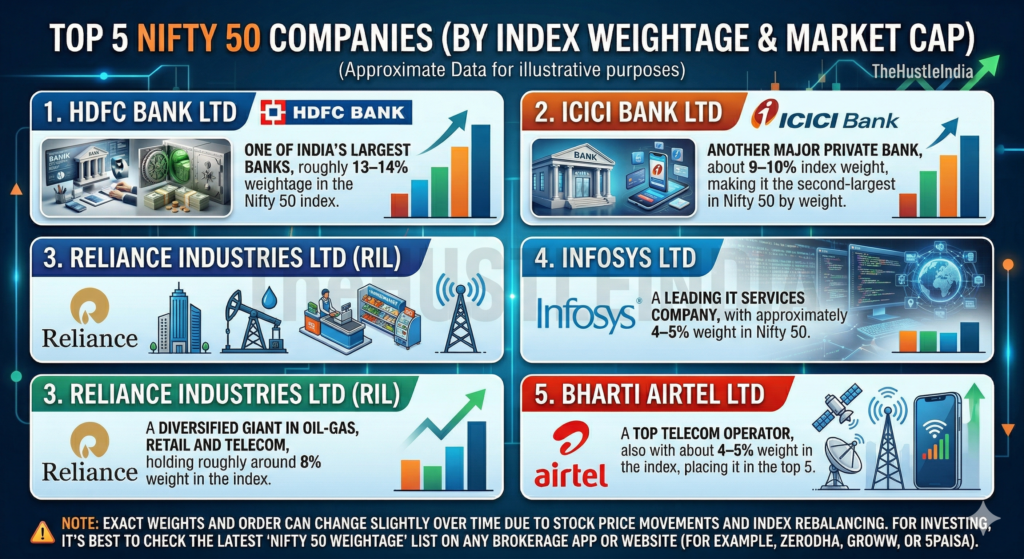
When you invest in a Nifty 50 index fund, for example, you’re instantly spread across 50 of India’s largest companies. Buying that same exposure by purchasing each stock individually would cost lakhs and require 50 separate transactions. Diversification reduces the damage any single bad pick can do to your portfolio.
“Diversification is the only free lunch in investing.” — Harry Markowitz, Nobel Prize-winning economist
2. No Expertise Required
Stock picking is genuinely hard. Even seasoned professional fund managers consistently fail to beat simple index funds over the long run. If the experts struggle, a beginner reading company balance sheets on weekends faces an even steeper climb. Mutual funds remove this burden entirely.
3. Systematic Investment Plans (SIPs)
One of the most powerful tools available to Indian investors is the SIP — a way to invest a fixed amount every month automatically. Starting with as little as ₹500/month, SIPs instil financial discipline and harness rupee-cost averaging: you buy more units when prices are low and fewer when they’re high, smoothing out market volatility over time.
The Case for Stocks
Stocks aren’t inherently dangerous — they’re just unforgiving of ignorance. In the right hands, individual stocks can generate returns that no mutual fund can match. Here’s when stocks make sense.
When You’ve Done the Homework
If you’ve genuinely studied a company — its business model, competitive moat, financial health, industry trends, and valuation — buying its stock can be a high-conviction bet. Warren Buffett didn’t build Berkshire Hathaway by buying index funds; he bought deeply understood businesses at fair prices.
No Fees, Full Control
Mutual funds charge an expense ratio — typically 0.1% to 2% annually. That might sound small, but on a ₹10 lakh portfolio, even 1% equals ₹10,000 per year compounding against you. Stocks have no ongoing management fees, just brokerage on each trade.
The Thrill of the Game
There’s also an educational and emotional case: buying your first stock in a company you understand — a brand you use, an industry you work in — makes you an engaged investor. You start reading annual reports, tracking earnings, understanding business cycles. That knowledge compounds alongside your money.
Head-to-Head: The Full Comparison
| Factor | Stocks | Mutual Funds | Winner |
|---|---|---|---|
| Risk | High (concentrated) | Lower (diversified) | Mutual Funds |
| Effort Required | High — research-intensive | Low — passive possible | Mutual Funds |
| Potential Returns | Unlimited (multi-baggers) | Market-linked, moderate | Stocks |
| Cost | Brokerage only | Expense ratio annually | Stocks |
| Minimum Investment | 1 share (varies by price) | ₹500/month via SIP | Mutual Funds |
| Liquidity | Instant (market hours) | T+1 to T+3 days | Stocks |
| Tax Efficiency | STCG/LTCG on each trade | LTCG on redemption only | Tie |
| Transparency | Full — you know what you own | Disclosed monthly | Stocks |
| Beginner-Friendliness | Steep learning curve | Simple to start | Mutual Funds |
Common Beginner Mistakes to Avoid
- Buying stocks based on tips from friends, social media, or WhatsApp groups
- Putting all money into one stock because you “believe in the company”
- Chasing last year’s top-performing mutual fund (past returns ≠ future results)
- Panic-selling during market corrections instead of staying invested
- Ignoring the expense ratio and investing in regular plans instead of direct plans
- Timing the market instead of spending time in the market
- Starting too late because you’re waiting for the “right moment”
The Verdict: Start with Mutual Funds, Graduate to Stocks
If you’re a complete beginner, start with a simple index fund SIP. Set it up, automate it, and leave it alone. A Nifty 50 or Nifty 500 index fund will give you diversified market exposure at rock-bottom costs while you spend the next 6–12 months learning how individual businesses work.
Once you understand balance sheets, P/E ratios, competitive moats, and how to read an annual report — once you have genuine conviction about a company’s future — you can begin allocating a small portion of your portfolio (10–20%) to individual stocks.
The goal isn’t stocks or mutual funds. The goal is to become a disciplined, informed investor. Mutual funds are training wheels that never actually need to come off.
Your Next Three Steps
Ready to begin? Here’s a simple action plan:
- Open a Demat + Mutual Fund account — platforms like Zerodha Coin, Groww, or ET Money make this free and paperless in under 30 minutes
- Start a SIP in a direct Nifty 50 index fund — even ₹1,000/month beats doing nothing while you research further
- Read one investing book — try “The Intelligent Investor” by Benjamin Graham or “Let’s Talk Money” by Monika Halan (India-specific and excellent)
The best investment you’ll ever make is the one you actually start. The market rewards the patient, the disciplined, and the consistent — not the brilliant, the lucky, or the perfectly-timed.
Disclaimer: This article is for educational purposes only and does not constitute financial advice. Please consult a SEBI-registered financial advisor before making investment decisions.