The Man in the Turban: How a Refugee’s Grit Spiced Up the World
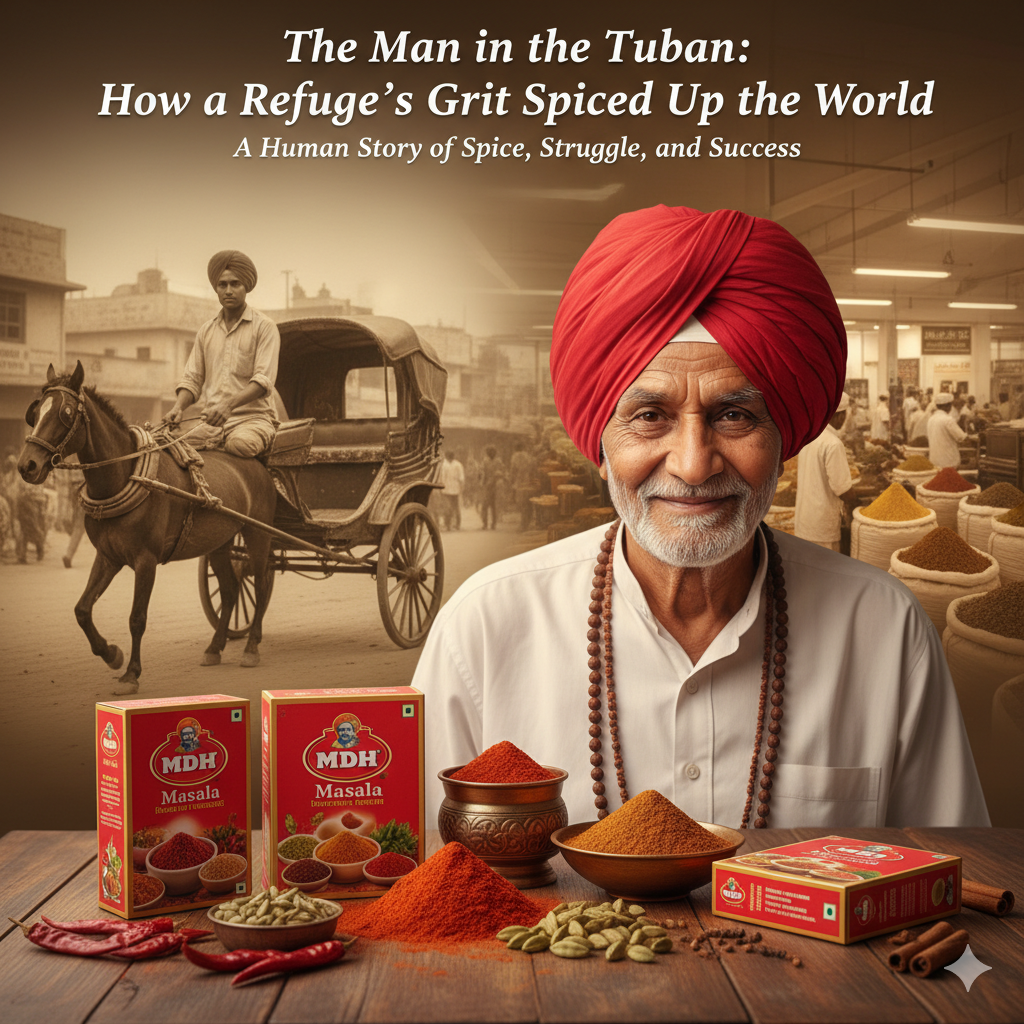
We all know the face. The signature red turban, the white mustache, the twinkling eyes, and that grandfatherly smile. For decades, Mahashay Dharampal Gulati was the most recognizable face in India. But before he was the “King of Spices,” he was just a man with a horse-drawn carriage and a heart full of hope.
This isn’t just a business case study; it’s a story about what happens when you lose everything but refuse to give up.
The Great Loss and a New Start
Imagine having a thriving family business, a home, and a community, only to have it all wiped away by a line drawn on a map. During the Partition in 1947, Dharampal ji left Sialkot for Delhi. He arrived with just 1,500 rupees—barely enough to survive, let alone start an empire.
He spent part of that money on a tonga (a horse carriage). For a few paise a ride, he transported people from New Delhi Railway Station to Karol Bagh. Can you imagine the man who would one day run a 1,600-crore company sitting behind a horse, wondering where his next meal would come from?
The “Purity” Obsession
Eventually, he realized that while he had lost his shop, he hadn’t lost his skill. He sold the tonga and set up a tiny wooden shack to sell spices.
At that time, the market was flooded with “cheap” spices—often mixed with fillers or colors. Dharampal ji took a different path. He decided that even if he stayed small, he would never lie to his customers. He personally ground the spices to ensure they were 100% pure.
The lesson here is simple: Quality is the best marketing. People realized that his spices made their food taste like home, and soon, the lines outside his tiny shack were longer than any of his competitors.
Why He Became His Own Brand Ambassador
People often asked why he didn’t hire a Bollywood star for his commercials. His answer was rooted in a deep understanding of human psychology.
In India, we trust our elders. When Dharampal ji appeared in those ads, he wasn’t just a CEO; he was everyone’s Dadaji. He wasn’t selling a product; he was giving his word. By putting his face on every box, he was saying, “I made this, and I stand by it.” That level of accountability is something modern brands often lack.
The Heart Behind the Business
Success didn’t change his soul. Even as he became the highest-paid CEO in the FMCG sector, he lived a remarkably simple life. He woke up at 4:00 AM, exercised, and was often the first one at the factory.
Perhaps the most human part of his story is what he did with his wealth. He didn’t just hoard it; he built hospitals and schools. When he passed away at 97, he didn’t leave behind just a company—he left behind a legacy of “Zinda Dili” (a life lived with a large heart).
What We Can Learn Today
You don’t need a fancy MBA to build something great. Dharampal ji only studied until the 5th grade. He didn’t have “venture capital.” He had:
Resilience: The ability to move from a tonga to a boardroom.
Trust: The understanding that a brand is a promise.
Hard Work: The discipline to stay involved until the very end.
The next time you see that box of MDH in your kitchen, look at the man in the turban. He’s a reminder that no matter how hard life hits you, you can always start again—one pinch of spice at a time.
Inspired by the business journey of Mahashay Dharampal Gulati.