Best Financial Planning Strategy for Young Indians in 2026
Your 20s and early 30s are the most powerful years for building wealth. Here is a clear, no-jargon guide to making smart money decisions — from your first salary to your first crore.
Most young Indians get their first real income between the ages of 21 and 25. And most of them spend the next five years figuring out money by trial and error — overspending in the beginning, panicking about savings later, and wondering somewhere around 28 why they haven’t managed to build any real wealth yet.
It doesn’t have to work that way.
Financial planning sounds complicated. Banks and investment firms have spent decades making it sound complicated — because confusion is profitable for them. But the core ideas are genuinely simple. You don’t need a finance degree, a fancy advisor, or a high salary to start building wealth in India today. You need a plan, a little discipline, and the patience to let time do most of the work.
This guide is written for someone earning their first salary, or anyone in their 20s or early 30s who wants to get their finances in order. We will go step by step — no jargon, no product selling, just what actually works.
The best time to start investing was yesterday. The second best time is today. The worst time is “once I earn more.”
Step 1: Know Where Your Money Goes
Step 01 · Foundation
Track your spending before you do anything else
You cannot plan what you cannot see. Before setting savings targets or picking investments, spend one month tracking exactly where every rupee goes. Most people are shocked by what they find — subscriptions they forgot about, food delivery adding up to Rs 8,000 a month, impulse buys that felt small individually but are large in total.
Use any simple method: a notes app, a spreadsheet, or apps like Money Manager, Walnut, or ET Money. The tool does not matter. The habit does.
- Split spending into fixed (rent, EMIs, insurance) and variable (food, entertainment, shopping)
- Identify your top 3 spending categories — those are where your money is going
- Do not try to cut everything at once — understand the picture first
Step 2: Use the 50-30-20 Rule as Your Starting Point
Once you know where your money goes, you need a framework to decide where it should go. The 50-30-20 rule is the simplest one that works for most young Indians with a steady income.
This is a starting point, not a law. If you live with parents and have low fixed costs, push savings to 30-40%. If you are paying high rent in Mumbai or Bengaluru, you may need to adjust needs to 60% temporarily. The principle — spend less than you earn, save the rest intentionally — is what matters.
Pay yourself first: As soon as your salary hits your account, move your savings amount to a separate account or investment immediately. Do not wait to save what is left at the end of the month — there will never be anything left. Automate it with an auto-debit SIP so the decision is already made for you.
Step 3: Build Your Emergency Fund First
Step 03 · Safety Net
3 to 6 months of expenses — kept liquid, kept separate
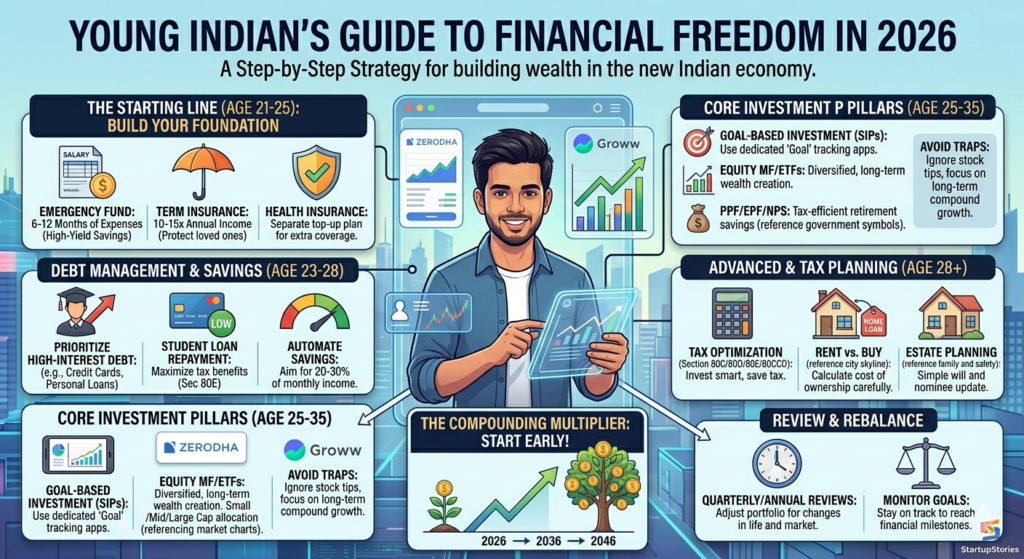
Before you invest a single rupee in stocks or mutual funds, you need an emergency fund. This is money that covers 3 to 6 months of your essential expenses — rent, food, EMIs, utilities — in case you lose your job, face a medical crisis, or need cash urgently.
Without this, any financial shock forces you to sell investments at the wrong time or take on debt. The emergency fund is what keeps a bad situation from becoming a financial disaster.
- Where to keep it: High-interest savings account (AU Small Finance Bank, IDFC First) or a liquid mutual fund — not a regular savings account earning 3%
- How much: 3 months if you have stable employment, 6 months if you are freelancing or in an uncertain industry
- How to build it: Set aside a fixed amount every month until you hit the target — even Rs 3,000 a month gets you there in a year
- Never touch it for non-emergencies. A sale on flights is not an emergency.
Step 4: Get Insurance Before You Think You Need It
Insurance is one of the most important and most ignored parts of financial planning for young Indians. The common mistake is thinking you do not need it when you are young and healthy. That is exactly backwards — young and healthy is the best time to get insured, because premiums are lowest and health issues have not appeared yet.
Term Life Insurance
If anyone depends on your income — parents, a spouse, siblings — you need term life insurance. A Rs 1 crore cover for a 25-year-old costs roughly Rs 700–900 per month. That is it. If something happens to you, your family gets Rs 1 crore. Do not buy ULIPs or endowment plans — they mix insurance with investment badly. Buy pure term insurance and invest separately.
Health Insurance
Even if your employer provides group health cover, buy your own individual health policy. Employer cover disappears when you change jobs, and starting fresh in your 30s means higher premiums and possible exclusions for pre-existing conditions. A Rs 10 lakh individual health cover costs roughly Rs 8,000–12,000 per year in your 20s. One hospitalisation without insurance can wipe out years of savings.
Avoid these common insurance mistakes: Do not buy insurance as an investment (ULIPs, endowment plans, money-back policies). Do not buy cover from your bank relationship manager without comparing online. And do not underinsure — Rs 5 lakh health cover is not enough in a city hospital in 2026.
Step 5: Start Investing — The Power of Starting Early
This is where the real wealth building happens. And the single most important thing to understand about investing is that time matters more than amount.
| Person | Starts SIP at | Monthly SIP | Stops at | Value at 60 (12% returns) |
|---|---|---|---|---|
| Priya | Age 23 | Rs 5,000 | Age 60 | Rs 3.24 crore |
| Rahul | Age 30 | Rs 5,000 | Age 60 | Rs 1.76 crore |
| Difference | 7 years earlier | Same amount | Same time | Rs 1.48 crore more |
Priya invests the same Rs 5,000 per month as Rahul but starts 7 years earlier. She ends up with nearly Rs 1.5 crore more at retirement without investing a single rupee extra per month. That is compounding. That is why starting early is the most powerful financial decision a young Indian can make.
Where to Invest in 2026
For Beginners
Equity Mutual Funds via SIP
If you are new to investing, starting a SIP in a diversified equity mutual fund is the single best move you can make. You invest a fixed amount every month, the fund manager handles stock selection, and you benefit from rupee cost averaging.
- Index funds (Nifty 50, Nifty Next 50) — lowest cost, no fund manager risk, excellent for long-term wealth building
- Flexi-cap funds — actively managed, invest across large, mid, and small cap stocks
- Where to start: Zerodha Coin, Groww, ET Money, or directly through an AMC website
- Minimum amount: As low as Rs 500 per month — start small and increase as income grows
For Debt and Stability
PPF, EPF, and Debt Funds
Not all your savings should be in equity. Debt instruments provide stability and guaranteed returns — important for goals that are 2 to 5 years away.
- PPF (Public Provident Fund) — 7.1% interest (tax-free), 15-year lock-in, sovereign guarantee. Perfect for long-term safe compounding. Max Rs 1.5 lakh per year.
- EPF — If you are salaried, your employer’s EPF contribution is essentially free money. Never withdraw EPF before retirement.
- Debt mutual funds — Better than FDs for medium-term goals (3–5 years), more tax-efficient
- Fixed Deposits — Still useful for emergency funds and short-term goals. Use small finance banks for higher rates.
For Advanced Investors
Direct Stocks, NPS, and REITs
Once you have your basics in place — emergency fund, insurance, SIPs running — you can explore additional options.
- Direct stocks — Higher potential returns, but requires research and emotional discipline. Do not start here.
- NPS (National Pension System) — Excellent for tax saving under Section 80CCD(1B) — additional Rs 50,000 deduction beyond the 80C limit.
- REITs (Real Estate Investment Trusts) — Own a slice of commercial real estate without buying property. Available on NSE/BSE like stocks.
- Gold — 5–10% of portfolio in Sovereign Gold Bonds (SGBs) or Gold ETFs, not physical gold jewellery.
Step 6: Save Tax — Legally and Smartly
India’s tax system offers real benefits to people who plan ahead. Most young salaried employees either ignore these or discover them in February and make rushed, bad decisions. Do not do that.
Section 80C (up to Rs 1.5 lakh deduction): EPF contributions, PPF, ELSS mutual funds, life insurance premium, home loan principal. ELSS funds give you equity exposure plus tax saving — the best of both within 80C.
Section 80D (health insurance premium): Up to Rs 25,000 for self and family, additional Rs 25,000 for parents. Another reason to buy health insurance.
Section 80CCD(1B) (NPS): Extra Rs 50,000 deduction over and above 80C. If you want to reduce tax further, this is the best option.
HRA exemption: If you pay rent, claim HRA. Keep rent receipts and your landlord’s PAN if annual rent exceeds Rs 1 lakh.
New Tax Regime vs Old Tax Regime in 2026
The new tax regime offers lower slab rates but removes most deductions. For most young Indians with home loans, significant 80C investments, and HRA claims — the old regime usually saves more tax. But if your deductions are low, the new regime might work better. Use any online tax calculator to compare both for your specific numbers before choosing.
Step 7: Set Goals and Match Investments to Timelines
Random saving without goals leads to random outcomes. Be specific about what you are saving for and when you need the money. Then pick the right instrument for that timeline.
Short-term goals (0–3 years) — Vacation, gadget, car down payment — Liquid funds, short-term debt funds, high-interest savings account
Medium-term goals (3–7 years) — House down payment, wedding, higher education — Balanced/hybrid mutual funds, debt funds, PPF
Long-term goals (7+ years) — Retirement, child’s education — Equity mutual funds, direct stocks, NPS, PPF
Rule of thumb: The longer the timeline, the more equity you can hold. The shorter the timeline, the safer the instrument should be.
Step 8: Avoid the Traps That Destroy Young Indians’ Wealth
Common Mistakes
Things that quietly wreck your financial progress
- Credit card debt: Cards at 36–42% annual interest are the fastest way to undo everything else. Pay your full balance every month or do not use a credit card.
- Insurance as investment: ULIPs, endowment plans, and money-back policies are high-commission products that give poor returns. Buy term for protection and mutual funds for growth — separately.
- Panic selling during market crashes: Every crash feels like the end of the world. It never is. Investors who lost money in stock markets are mostly those who sold in panic and never returned.
- Waiting to start: Rs 2,000 invested at 23 beats Rs 10,000 invested at 30. Start with whatever you have right now.
- Personal loans for consumption: A personal loan at 14–18% interest to fund a vacation or upgrade your phone is very expensive. Save first, then buy.
- Ignoring inflation: FDs earning 7% when inflation is 5–6% barely grow your money in real terms. Long-term wealth needs equity exposure.
Your Financial Planning Checklist for 2026
Use this to audit where you stand right now:
- I track my monthly income and expenses consistently
- I follow (or am working toward) a 50-30-20 savings split
- I have 3–6 months of expenses in an emergency fund in a liquid account
- I have term life insurance if anyone depends on my income
- I have personal health insurance independent of my employer’s cover
- I have at least one SIP running in an equity mutual fund or index fund
- I have a PPF account or am contributing to EPF consistently
- I have used my 80C limit (Rs 1.5 lakh) for tax saving this year
- I have written down my top 3 financial goals with timelines and amounts
- I have no high-interest consumer debt — credit cards paid in full, no lifestyle loans
If you can check off 7 or more of these, you are genuinely ahead of most Indians your age. If fewer than 5, this article gives you a clear starting point.
Rough Wealth Benchmarks by Age
By age 25: Emergency fund of 3 months’ expenses. At least one SIP running. Term and health insurance in place.
By age 28: Emergency fund of 6 months. Savings roughly equal to 1x your annual salary. 80C fully utilized every year.
By age 30: Net worth (investments minus any debt) of at least 1.5x your annual salary. Clear financial goals for the next 5–10 years written down.
By age 35: Net worth of 3–4x annual salary. Retirement corpus growing on autopilot. If you have a home loan, a clear repayment plan in place.
The One Mindset That Makes Everything Else Work
All the strategies in this article are useless without one thing: consistency. Financial planning is not about making one brilliant investment. It is about doing the boring right things — tracking, saving, investing — month after month, year after year, without stopping when markets fall or when life gets busy.
The Indians who build real wealth in their 40s and 50s are almost never the ones who made some spectacular investment call in their 20s. They are the ones who started a Rs 3,000 SIP at 24, kept increasing it every year, did not panic in 2020 when markets crashed 35%, and let compounding do what compounding does when you give it enough time.
You do not need to be brilliant at finance. You need to be consistent, patient, and honest with yourself about where your money is going.
Where to Start Today — In 5 Minutes
If you want to take action right now, here is the shortest possible starting plan:
- Download a tracking app (Money Manager or Walnut) and log today’s spending
- Open Groww or Zerodha Coin and start a Rs 500 SIP in a Nifty 50 index fund — takes 10 minutes
- Open PolicyBazaar and get a term insurance and health insurance quote — just to know the number
- Open a PPF account at your bank or post office if you do not have one — deposit even Rs 500 to activate it
- Write down one financial goal — a specific number, and a date by which you want to reach it
Five things. Do them this week and you are already ahead of most people your age who are still waiting for the “right time” to start.