10 Strategies Behind Croma’s Success in India’s Consumer Electronics Market
How India’s first large-format electronics retailer built a dominant brand and keeps winning.
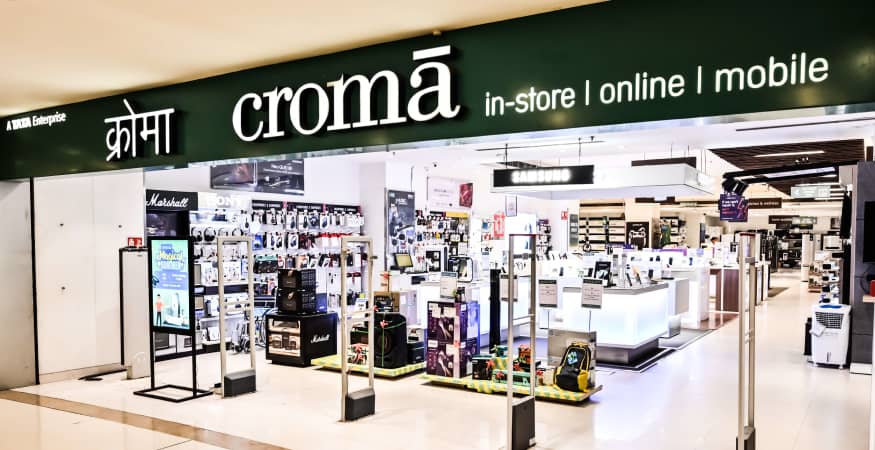
Founded in 2006 as a wholly-owned subsidiary of Tata Sons, Croma has grown from a single store in Juhu, Mumbai into India’s most trusted consumer electronics retail chain — with 515+ stores across 171 cities. Here are the 10 strategies that have powered its rise.
01
The Tata Trust Advantage
In India’s consumer electronics market, trust is everything. Croma’s biggest competitive asset has never been a product or a price — it’s the Tata brand. As a subsidiary of Tata Sons under Infiniti Retail Ltd., Croma inherited one of India’s most respected corporate legacies from its very first day.
For consumers making large, infrequent purchases like televisions or refrigerators, the fear of being misled is real. The Tata parentage directly addressed this anxiety, giving Croma instant credibility in a market dominated by opaque, commission-driven small dealers.
02
“We Help You Buy” — A Customer-First Philosophy
When Croma launched, India’s electronics retail culture was driven by dealer incentives, not customer needs. Croma’s founding promise — “We help you buy” — was a radical departure. It meant trained staff who guide purchases honestly, live demo zones where customers can touch and try products, and an environment free of sales pressure.
Nearly two decades later, this philosophy has evolved into Croma’s “Store of the Future” model, built on five pillars: purpose-centric engagement, expert guidance, immersive product experiences, frictionless convenience, and speed of service. The core customer-first idea remains unchanged.
03
Omnichannel Retail — Online and Offline, Seamlessly United
Croma launched Croma.com in 2012, well before omnichannel became a retail industry mandate. The insight was clear: Indian electronics consumers research extensively online but often prefer to commit offline. Croma decided to own both sides of the journey.
Between 2019 and 2024, Croma partnered with Tata Consultancy Services (TCS) to deploy the AI-powered TCS OmniStore platform. In August 2024, Croma became the first retailer in India to enable 100% in-store mobile checkout across all stores. Features like Endless Aisle (ordering products not physically in store), express delivery within hours, and Shop with Video (live demo calls with nearly 70% follow-up conversion) make Croma a genuine omnichannel leader.
04
Private Label Products — Exclusivity and Margin Control
Croma operates in a structurally thin-margin industry, squeezed between powerful national brands and aggressive e-commerce pricing. Its answer was a private label strategy launched in 2008 in partnership with Woolworths Wholesale of Australia, and fully internalized after acquiring that business in 2012 for approximately ₹200 crore.
Today, Croma’s own-label range covers 400+ products across multiple categories — all curated by in-house experts and priced competitively. Crucially, these products are available only through Croma, making comparison shopping on Amazon or Flipkart impossible. This exclusivity is a powerful differentiator in an age of frictionless price comparison.
05
Aggressive Store Expansion into Tier-2 and Tier-3 Cities
For years, Croma was primarily a metros-first brand. As India’s electronics market expanded rapidly into smaller cities, Croma shifted strategy and accelerated its store rollout significantly — launching more stores in the three years leading up to 2024 than in its entire prior 16 years of existence.
Today, Croma operates 515+ stores across 171 cities, including 15 TRiBE specialty format stores. Expansion into suburban metro regions and Tier-2 and Tier-3 cities ensures Croma reaches the next generation of Indian consumers where they actually live, while its dense store network also serves as local fulfilment infrastructure for same-day delivery orders.
06
Lifetime Assurance — Owning the Full Customer Lifecycle
In most of India’s electronics retail, the relationship ends at the point of sale. Croma disrupted this norm with its Lifetime Assurance promise — taking responsibility for facilitating repair and after-sales service for the products it sells, coordinating directly with brands on the customer’s behalf.
This commitment, reinforced by its Zip Care Protect service plans and its role as an authorised service station for several brands, transforms Croma from a seller into a long-term partner. In a category where post-purchase anxiety is high, this lifecycle ownership is a significant loyalty driver.
07
Tata Neu Integration — A Super-App Loyalty Engine
Most electronics retailers run isolated loyalty programmes. Croma’s integration into the Tata Neu super-app fundamentally changes this equation. Tata Neu brings together Croma, BigBasket, AirAsia India, 1mg, Westside, Starbucks, and Tata CLiQ under one app and one loyalty currency — NeuCoins — that works across all of them.
A customer earning points on groceries can redeem them on a television. A frequent flyer can apply travel rewards to a laptop purchase. This cross-category engagement creates stickiness that no standalone electronics retailer can replicate. The Tata Neu credit card adds another layer, rewarding high-spend customers across the entire ecosystem.
08
Vast Assortment and Premium Brand Partnerships
With 25,000+ products across 547 brands — including Apple, Samsung, Sony, LG, and HP — Croma positions itself as a one-stop destination, reducing the need for consumers to visit multiple speciality stores. Strategic partnerships with premium brands have secured Croma preferred launch partner status for flagship products, including iPhone releases.
Croma’s own Year-End Consumer Trends 2025 report confirmed the premium shift in full effect — one in three smartphones sold was in the ₹20,000–₹30,000 band, and the ₹50,000–₹58,000 price corridor grew over 300% year-on-year. Croma’s expert-led, experience-rich retail environment actively supports this premiumisation trend.
09
Smart Pricing, Festive Campaigns and Value Tiers
Croma operates a multi-layered pricing strategy. Competitive base pricing retains price-sensitive customers who might otherwise shop online. Value-based pricing on premium products is supported by Tata’s trust premium. Festive season campaigns — timed around Diwali, Republic Day, and Back-to-School periods — drive coordinated online and offline traffic spikes.
Campaigns like #MagicalSummerSale have demonstrated Croma’s digital marketing sharpness, generating over 655,000 views with a 16% engagement rate — well above the industry benchmark of 1–5%. EMI and buy-now-pay-later options with banking partners make high-value products accessible to a wider income range.
10
Sustainability — E-Waste, Energy Efficiency and Purpose
As India’s electronics consumption grows, so does the challenge of e-waste. Croma has embedded sustainability into its brand purpose through its partnership with JustDispose, a certified recycling company. Customers can drop off old electronics at Croma stores and receive a small token of appreciation — including having a tree planted in their name.
Croma also actively promotes energy-efficient products, and its Lifetime Assurance model inherently extends product lifecycles, reducing unnecessary replacements. These commitments resonate with India’s growing urban, environmentally aware consumer segment and add a meaningful dimension to the brand beyond price and product.
All 10 Strategies at a Glance
- Tata Trust Advantage — built-in brand credibility from day one
- “We Help You Buy” — genuine customer-first retail philosophy
- Omnichannel Leadership — 30x digital GMV growth, mobile checkout first in India
- Private Label Products — 400+ exclusive SKUs for margin and exclusivity
- Aggressive Store Expansion — 515+ stores across 171 cities
- Lifetime Assurance — after-sales ownership that drives repeat business
- Tata Neu Integration — cross-category loyalty no competitor can replicate
- Premium Assortment — 25,000+ products across 547 brands
- Smart Pricing and Festive Campaigns — 58% organised retail market share
- Sustainability — e-waste programmes and energy-efficiency focus
Final Thoughts
Croma’s success is not the result of any single clever tactic. It is the outcome of nearly two decades of disciplined, compounding strategy — layering Tata trust with genuine customer service, technology-powered omnichannel convenience, margin-improving private labels, and an unmatched loyalty ecosystem through Tata Neu.
As India’s consumer electronics market is projected to grow from $83.9 billion in 2024 toward $162 billion by 2034, Croma’s combination of retail experience, ecosystem integration, and expanding physical presence positions it well to remain the category’s most trusted name for years to come.